Python Read Text File Skip First Character
In the recent couple of articles, we've looked at different ways to remove characters from strings in Excel. Today, we'll investigate one more employ case - how to delete everything before or afterwards a specific character.
Delete text before, after or betwixt ii characters with Detect & Replace
For information manipulations in multiple cells, Find and Supercede is the right tool. To remove part of a cord preceding or following a specific graphic symbol, these are the steps to perform:
- Select all the cells where you want to delete text.
- Press Ctrl + H to open the Find and Replace dialog.
- In the Detect what box, enter i of the post-obit combinations:
- To eliminate text before a given character, type the character preceded by an asterisk (*char).
- To remove text subsequently a certain character, type the grapheme followed by an asterisk (char*).
- To delete a substring betwixt two characters, type an asterisk surrounded by two characters (char*char).
- Leave the Replace with box empty.
- Click Supervene upon all.
For example, to remove everything after a comma including the comma itself, put a comma and an asterisk sign (,*) in the Find what box, and you lot'll get the following upshot:
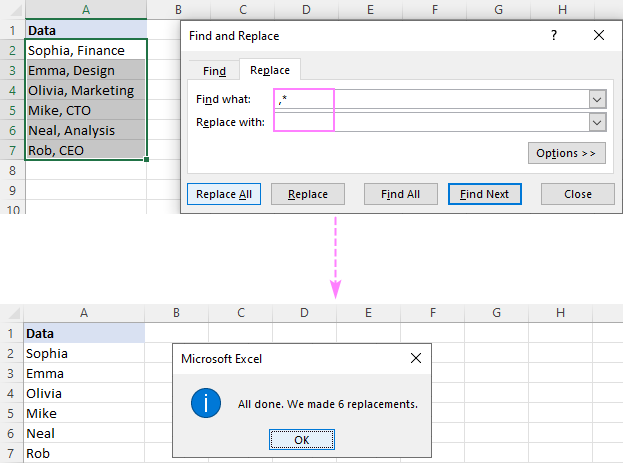
To delete a substring before a comma, type an asterisk, a comma, and a space (*, ) in the Find what box.
Please observe that we are replacing not simply a comma but a comma and a space to prevent leading spaces in the results. If your data is separated by commas without spaces, so use an asterisk followed by a comma (*,).

To delete text betwixt two commas, use an asterisk surrounded by commas (,*,).
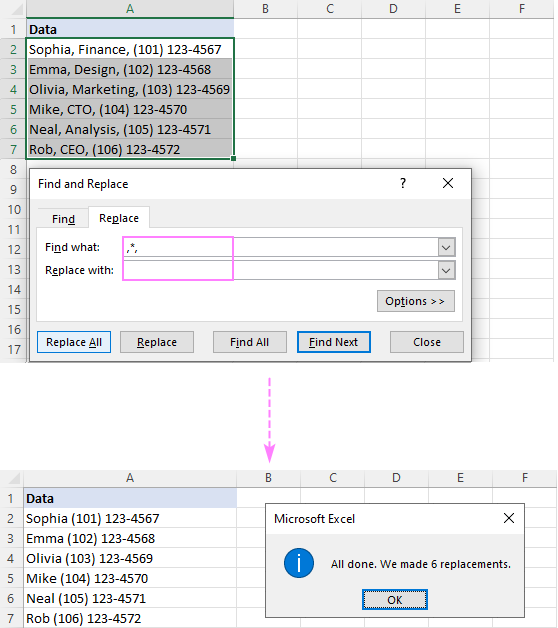
Tip. If you'd rather have the names and phone numbers separated by a comma, and then type a comma (,) in the Replace with field.
Remove part of text using Flash Fill
In mod versions of Excel (2013 and later), in that location is one more like shooting fish in a barrel way to eradicate text that precedes or follows a specific character - the Wink Make full feature. Hither's how information technology works:
- In a cell next to the first cell with your data, blazon the expected consequence and press Enter.
- Starting time typing an appropriate value in the next cell. Once Excel feels the pattern in the values you are entering, it will display a preview for the remaining cells following the same pattern.
- Hit the Enter key to accept the suggestion.
Washed!

Remove text using formulas
In Microsoft Excel, many data manipulations performed by using inbuilt features can also exist accomplished with a formula. Unlike the previous methods, formulas exercise not brand any changes to the original information and give yous more command over the results.
How to remove everything subsequently a specific grapheme
To delete text later on a particular grapheme, the generic formula is:
LEFT(jail cell, SEARCH("char", cell) -1)
Hither, we apply the SEARCH function to get the position of the character and pass it to the LEFT function, so it extracts the corresponding number of characters from the beginning of the cord. One character is subtracted from the number returned past SEARCH to exclude the delimiter from the results.
For example, to remove part of a string later a comma, you lot enter the below formula in B2 and drag it downward through B7:
=LEFT(A2, SEARCH(",", A2) -one)

How to remove everything before a specific character
To delete part of a text cord before a certain character, the generic formula is:
RIGHT(cell, LEN(cell) - SEARCH("char", cell))
Here, we again summate the position of the target graphic symbol with the help of SEARCH, subtract it from the full cord length returned by LEN, and pass the difference to the RIGHT function, so information technology pulls that many characters from the stop of the string.
For case, to remove text before a comma, the formula is:
=Right(A2, LEN(A2) - SEARCH(",", A2))
In our case, the comma is followed by a infinite character. To avoid leading spaces in the results, we wrap the cadre formula in the TRIM function:
=TRIM(Right(A2, LEN(A2) - SEARCH(",", A2)))

Notes:
- Both of the higher up examples assume that there is only ane instance of the delimiter in the original string. If there are multiple occurrences, text volition be removed before/later the first case.
- The SEARCH function is not instance-sensitive, meaning it makes no departure between lowercase and capital letter characters. If your specific graphic symbol is a letter and yous want to distinguish the alphabetic character case, then use the case-sensitive FIND part instead of SEARCH.
How to delete text after Nth occurrence of a character
In situation when a source cord contains multiple instances of the delimiter, you may have a need to remove text after a specific instance. For this, use the following formula:
LEFT(cell, Notice("#", SUBSTITUTE(cell, "char", "#", n)) -1)
Where n is the character'southward occurrence after which to remove text.
The internal logic of this formula requires using some character that is not nowadays anywhere in the source data, a hash symbol (#) in our case. If this character occurs in your data fix, then use something else instead of "#".
For example, to remove everything after the 2nd comma in A2 (and the comma itself), the formula is:
=LEFT(A2, Notice("#", SUBSTITUTE(A2, ",", "#", 2)) -1)

How this formula works:
The key function of the formula is the FIND function that calculates the position of the nth delimiter (comma in our instance). Here'south how:
We replace the 2nd comma in A2 with a hash symbol (or any other character that does not exist in your data) with the help of SUBSTITUTE:
SUBSTITUTE(A2, ",", "#", two)
The resulting string goes to the twond statement of FIND, so information technology finds the position of "#" in that cord:
FIND("#", "Emma, Blueprint# (102) 123-4568")
FIND tells us that "#" is the thirteenth grapheme in the string. To know the number of characters preceding information technology, merely decrease 1, and you'll become 12 equally the result:
FIND("#", SUBSTITUTE(A2, ",", "#", two)) - ane
This number goes directly to the num_chars argument of LEFT asking it to pull the first 12 characters from A2:
=LEFT(A2, 12)
That's it!
How to delete text before Nth occurrence of a character
The generic formula to remove a substring before a certain character is:
RIGHT(SUBSTITUTE(prison cell, "char", "#", northward), LEN(cell) - Discover("#", SUBSTITUTE(jail cell, "char", "#", n)) -1)
For example, to strip off text before the 2nd comma in A2, the formula is:
=RIGHT(SUBSTITUTE(A2, ",", "#", 2), LEN(A2) - FIND("#", SUBSTITUTE(A2, ",", "#", 2)) -ane)
To eliminate a leading infinite, we again utilize the TRIM function as a wrapper:
=TRIM(RIGHT(SUBSTITUTE(A2, ",", "#", 2), LEN(A2) - Notice("#", SUBSTITUTE(A2, ",", "#", ii))))

How this formula works:
In summary, nosotros discover out how many characters are subsequently the nth delimiter and extract a substring of the corresponding length from correct. Below is the formula break downwardly:
Start, we replace the twond comma in A2 with a hash symbol:
SUBSTITUTE(A2, ",", "#", ii)
The resulting string goes to the text argument of Right:
RIGHT("Emma, Pattern# (102) 123-4568", …
Next, we need to define how many characters to extract from the terminate of the string. For this, we find the position of the hash symbol in the in a higher place string (which is xiii):
FIND("#", SUBSTITUTE(A2, ",", "#", ii))
And decrease it from the full cord length (which equals to 28):
LEN(A2) - FIND("#", SUBSTITUTE(A2, ",", "#", two))
The departure (15) goes to the second argument of Correct instructing information technology to pull the last 15 characters from the cord in the first statement:
Right("Emma, Blueprint# (102) 123-4568", 15)
The output is a substring " (102) 123-4568", which is very close to the desired outcome, except a leading space. And so, we use the TRIM function to go rid of it.
How to remove text afterwards the last occurrence of a graphic symbol
In case your values are separated with a variable number of delimiters, you may want to remove everything after the last instance of that delimiter. This tin be done with the following formula:
LEFT(cell, FIND("#", SUBSTITUTE(prison cell, "char", "#", LEN(jail cell) - LEN(SUBSTITUTE(cell, "char ", "")))) -1)
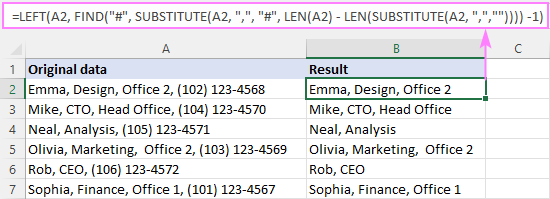
Suppose column A contains various data about employees, but the value after the last comma is always a telephone number. Your goal is to remove phone numbers and keep all other details.
To achieve the goal, you lot can remove text afterwards the terminal comma in A2 with this formula:
=LEFT(A2, Observe("#", SUBSTITUTE(A2, ",", "#", LEN(A2) - LEN(SUBSTITUTE(A2, ",","")))) -1)
Copy the formula down the cavalcade, and you'll get this consequence:
How this formula works:
The gist of the formula is that nosotros determine the position of the final delimiter (comma) in the cord and pull a substring from left upwardly to the delimiter. Getting the delimiter's position is the trickiest part, and here'south how we handle information technology:
First, nosotros find out how many commas there are in the original string. For this, we supplant each comma with nothing ("") and serve the resulting string to the LEN office:
LEN(SUBSTITUTE(A2, ",",""))
For A2, the result is 35, which is the number of characters in A2 without commas.
Decrease the to a higher place number from the total cord length (38 characters):
LEN(A2) - LEN(SUBSTITUTE(A2, ",",""))
… and you volition get 3, which is the total number of commas in A2 (and also the ordinal number of the last comma).
Side by side, you use the already familiar combination of the Discover and SUBSTITUTE functions to go the position of the last comma in the string. The instance number (3rd comma in our case) is supplied by the to a higher place-mentioned LEN SUBSTITUTE formula:
FIND("#", SUBSTITUTE(A2, ",", "#", 3))
It appears that the 3rd comma is the 23rd character in A2, meaning we need to extract 22 characters preceding it. So, nosotros put the above formula minus one in the num_chars argument of LEFT:
LEFT(A2, 23-one)
How to remove text earlier the last occurrence of a graphic symbol
To delete everything earlier the last example of a specific grapheme, the generic formula is:
Correct(prison cell, LEN(cell) - Find("#", SUBSTITUTE(cell, "char", "#", LEN(cell) - LEN(SUBSTITUTE(cell, "char", "")))))
In our sample table, to eradicate text before the terminal comma, the formula takes this form:
=Right(A2, LEN(A2) - FIND("#", SUBSTITUTE(A2, ",", "#", LEN(A2) - LEN(SUBSTITUTE(A2, ",","")))))
As a finishing touch, we nest it into the TRIM function to eliminate leading spaces:
=TRIM(Correct(A2, LEN(A2) - FIND("#", SUBSTITUTE(A2, ",", "#", LEN(A2) - LEN(SUBSTITUTE(A2, ",",""))))))

How this formula works:
In summary, nosotros go the position of the last comma equally explained in the previous example and decrease information technology from the full length of the string:
LEN(A2) - FIND("#", SUBSTITUTE(A2, ",", "#", LEN(A2) - LEN(SUBSTITUTE(A2, ",",""))))
As the result, we get the number of characters after the last comma and laissez passer information technology to the RIGHT function, so it brings that many characters from the end of the string.
Custom function to remove text on either side of a grapheme
Every bit you have seen in the higher up examples, you tin resolve almost any utilise example by using Excel's native functions in dissimilar combinations. The problem is that you need to recall of handful of tricky formulas. Hmm, what if we write our own function to cover all the scenarios? Sounds like a good idea. So, add the following VBA code to your workbook (the detailed steps to insert VBA in Excel are hither):
Role RemoveText(str As String, delimiter Every bit String, occurrence As Integer, is_after As Boolean) Dim delimiter_num, start_num, delimiter_len As Integer Dim str_result As String delimiter_num = 0 start_num = one str_result = "" delimiter_len = Len(delimiter) For i = 1 To occurrence delimiter_num = InStr(start_num, str, delimiter, vbTextCompare) If 0 < delimiter_num Then start_num = delimiter_num + delimiter_len Terminate If Next i If 0 < delimiter_num Then If True = is_after And then str_result = Mid(str, 1, start_num - delimiter_len - 1) Else str_result = Mid(str, start_num) End If End If RemoveText = str_result End Office
Our role is named RemoveText and it has the post-obit syntax:
RemoveText(string, delimiter, occurrence, is_after)
Where:
String - is the original text cord. Can be represented past a jail cell reference.
Delimiter - the grapheme before/after which to remove text.
Occurrence - the instance of the delimiter.
Is_after - a Boolean value that indicates on which side of the delimiter to remove text. Can be a single grapheme or a sequence of characters.
- TRUE - delete everything later the delimiter (including the delimiter itself).
- FALSE - delete everything before the delimiter (including the delimiter itself).
Once the function'due south code is inserted in your workbook, you can remove substrings from cells using compact and elegant formulas.
For example, to erase everything later the onest comma in A2, the formula in B2 is:
=RemoveText(A3, ", ", i, True)
To delete everything before the 1st comma in A2, the formula in C2 is:
=RemoveText(A3, ", ", 1, Fake)
Since our custom function accepts a cord for the delimiter, we put a comma and a space (", ") in the 2nd argument to spare the trouble of trimming leading spaces afterwards.
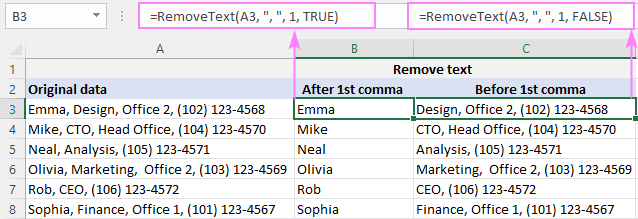
Our custom office works beautifully, doesn't it? Only if you remember information technology's the comprehensive solution, you haven't seen the side by side case even so :)
Delete everything earlier, later or between characters
To get even more than options for removing individual characters or text from multiple cells, by match or position, add together our Ultimate Suite to your Excel toolbox.
Here, we'll have a closer look at the Remove by Position feature located on the Ablebits Data tab > Text group > Remove.

Below, we volition cover the two most common scenarios.
Remove everything before or after certain text
Suppose all your source strings comprise some common discussion or text and yous wish to delete everything earlier or after that text. To have it done, select your source data, run the Remove by Position tool, and configure it like shown beneath:
- Select the All characters before text or All characters after text option and blazon the central text (or character) in the box next to it.
- Depending on whether majuscule and lowercase messages should be treated as dissimilar or the same characters, check or uncheck the Case-sensitive box.
- Striking Remove.
In this instance, we are removing all characters preceding the word "error" in cells A2:A8:

And get exactly the result we are looking for:

Remove text between two characters
In state of affairs when irrelevant information is between 2 specific characters, here's how you can speedily delete it:
- Cull Remove all substrings and blazon two characters in the below boxes.
- If the "betwixt" characters should be removed too, cheque the Including delimiters box.
- Click Remove.

As an example, we delete everything betwixt two tilde characters (~), and go the perfectly cleaned strings as the result:

To try other useful features included with this multi-functional tool, I encourage yous to download an evaluation version at the terminate of this mail. Thanks for reading and promise to encounter you on our web log adjacent week!
Bachelor downloads
Remove first or final characters - examples (.xlsm file)
Ultimate Suite - trial version (.cipher file)
You lot may as well be interested in
curriedrebeguing1998.blogspot.com
Source: https://www.ablebits.com/office-addins-blog/remove-text-before-after-between-characters-excel/
0 Response to "Python Read Text File Skip First Character"
Postar um comentário